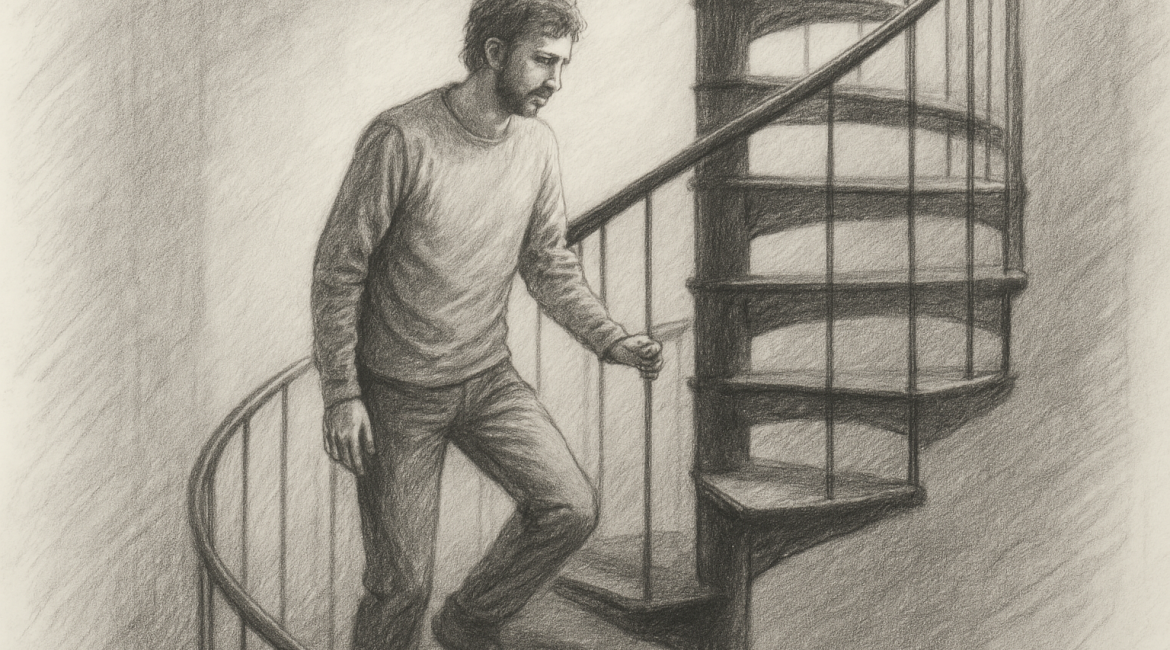

The Spiral Path of Real Recovery

A pencil sketch of a solitary figure seated on a staircase, reflecting the quiet, layered journey of healing.

Healing Doesn’t Happen in a Straight Line — But It Does Happen

We live in a culture that glorifies progress as a straight climb — upward, linear, logical. We imagine healing like a staircase, where every session, every insight, is a step closer to “done.” But what if true recovery doesn’t follow the rules of geometry?

What if healing is less like a ladder……and more like a spiral staircase, circling back to the same pain — but from new angles, with deeper wisdom, and a steadier heart? Welcome to the spiral path of real recovery, where progress is disguised in the returning, and every loop is a layer closer to wholeness.

The Myth of Linear Healing — And Why It Hurts So Many People

Why We Expect the Climb to Be Straight

From school to work to fitness goals, we’re taught to associate success with consistency. If you’re not constantly improving, you must be failing, right?

This thinking bleeds into mental health. You finally open up in therapy. You feel lighter. You’re “better.” Then — out of nowhere — the sadness hits again. The anxiety. The triggers.

  • “What’s wrong with me?”

  • “Didn’t I already deal with this?”

  • “Why am I back here again?”

It feels like being pulled under after you’ve already swum to shore. But here’s the truth: you’re not failing — you’re healing deeper.

The Shame Loop That Halts Recovery

This linear lie doesn’t just create frustration. It births shame — the toxic voice that says:

  • “You should be over this by now.”

  • “You’re too broken.”

  • “You’ll never get better.”

Shame is sneaky. It doesn’t just whisper — it paralyzes. It keeps people from continuing therapy. It drives them to numb or quit. It convinces them that their healing journey has ended — when really, it’s just rounding a bend.

Understanding the Spiral: How Trauma Healing Actually Works

Trauma Isn’t a Memory — It’s a Loop

Trauma isn’t a “bad memory” filed away neatly in your mind. It’s a neural loop — a survival pattern coded into your body. When triggered, your nervous system doesn’t know it’s 2025 — it reacts like it’s still 2005. Or 1997. Or whenever the rupture happened.

These loops run deep. And they don’t unwind just because you “understand” your story. Healing trauma means reprocessing it, not just recalling it.

The Spiral of Integration

  • You’re safer.

  • You have language.

  • You have support.

  • You have tools.

You spiral around the same pain — but now you meet it with different eyes. You integrate another piece. You stitch another thread into your nervous system. That’s the spiral. Not regression — progression through recursion.

EMDR: A Tool Designed for the Spiral Path

A person walking up a glowing spiral staircase, symbolizing healing and personal growth in soft light.

Why Traditional Talk Therapy Isn’t Enough

Talk therapy is powerful — but it often stays in the thinking brain. It helps you understand the “why” — but trauma lives in the body, not the intellect.

You can talk about your trauma for years and still feel hijacked by it in your body. That’s where EMDR (Eye Movement Desensitization and Reprocessing) steps in — as a deeper, more somatic modality.

What EMDR Actually Does

EMDR uses bilateral stimulation (like eye movements or tapping) while guiding you through traumatic memories in a structured way. The result?

  • Your brain reprocesses old experiences as “past” — not present danger.

  • The charge diminishes.

  • Your body begins to unlearn the panic.

What makes EMDR unique is that it doesn’t just target one layer — it follows the spiral. It meets the memory where it lives, layer by layer.

Healing Happens in Rounds

Clients often say things like: “I thought I was done with this memory — why is it coming back?” That’s not a failure. That’s your system trusting you with the next layer. EMDR doesn’t force the spiral open — it honors its timing.

Each round of EMDR:

  • Softens the reaction.

  • Unlocks buried insights.

  • Integrates fragmented parts.

You’re not going backward — you’re going deeper inward.

How to Track Progress When Healing Feels Like Circling

Rethinking What Progress Looks Like

Progress in the spiral model isn’t about never feeling pain again. It’s about:

  • Reacting differently to the same triggers.

  • Recovering faster when dysregulated.

  • Feeling safer in your own skin.

  • Recognizing patterns with compassion, not panic.

Signs You’re Healing, Even If It Doesn’t Feel Like It

  • You pause before reacting — even if it’s just once.

  • You cry and let yourself cry — without shame.

  • You notice when you dissociate — and come back quicker.

  • You choose rest over self-punishment.

  • You ask for help — and actually accept it.

Healing isn’t loud. Often, it’s quiet. Slow. Subtle. But it adds up. Every spiral is a stitch in your nervous system’s new story.

Take the Stairs — Not the Shortcut

Healing doesn’t move in straight lines. It spirals, bringing you back to familiar pain, but with new insight, new strength, and deeper healing each time. That’s not failure. That’s progress. If you’ve ever thought, “I should be past this by now,” you’re not alone. You’re just human. Real recovery isn’t about powering through, it’s about meeting each layer with grace. EMDR therapy honors that process. 

You don’t have to start over. You’re already on the path. Grab your copy today on Amazon and discover how EMDR supports lasting, spiral-shaped healing that sticks, so you can move forward with peace, clarity, and self-compassion.

_______________________________________
Introducing Insights Alchemy Newsletter
Let’s keep your edge sharp! If this book shifted something in you, a spark of insight, a fresh perspective, a challenge to the status quo, imagine a steady stream of those sparks landing in your inbox, week after week. AILKEMY isn’t your average newsletter. It’s where real-world grit meets forward-looking strategy. We'll curate research, human-centered frameworks, and hard-won lessons to help you lead with empathy and clarity.
Kaperider newsletter e1752550699862 Healing Doesn’t Happen in a Straight Line — But It Does Happen
Each newsletter delivers crisp foresight, actionable strategy, and narrative-driven insight, so you don’t just keep pace. You stay ahead. It’s free to start. It’s purposeful. And it’s built for thinkers who want more than ideas. They want impact.

SUBSCRIBE TO AILKEMY