Why the Future Is Not a Forecast, It’s a Design Process

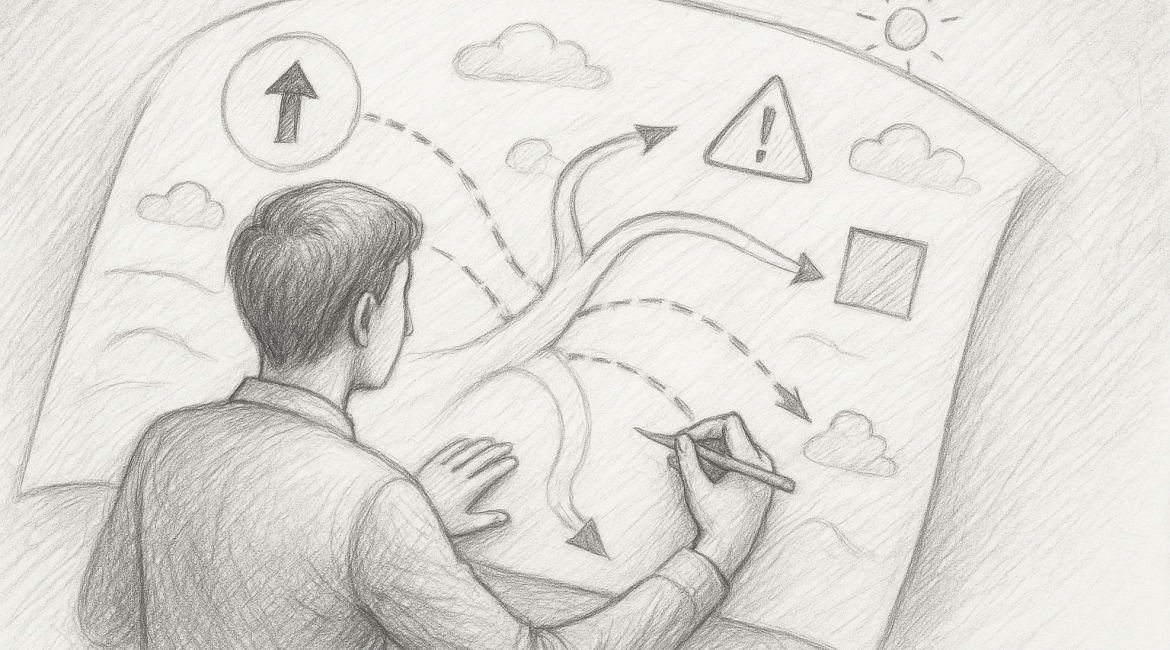
A pencil sketch of a person mapping multiple future pathways, symbolizing the shift from prediction to designing adaptable strategies.

Don’t Predict. Prepare

In an era of accelerating change, Futures Thinking is no longer an optional skill—it is a strategic necessity. The old reliance on fixed forecasts and linear predictions is crumbling. Instead of clinging to brittle projections, we must learn to design flexible pathways into multiple possible tomorrows. The future is not a date on the calendar, it is a space we actively create.

Why Forecasting Has Failed

Traditional forecasting assumes that the future is an extension of the present, projecting trends forward in a straight line. This model fails because it ignores disruptive innovations, geopolitical shocks, environmental tipping points, and social movements that reshape reality overnight.

The 2008 financial crisis, the COVID-19 pandemic, and the rapid rise of artificial intelligence each revealed the fragility of forecasts. Predictions collapsed under the weight of unforeseen events, leaving decision-makers blindsided. This failure underscores a central truth of Futures Thinking: the future is not predictable, but it is designable.

The Problem with “Preferred Futures”

Many planning models focus narrowly on a “preferred future”, an idealized vision of success. While inspirational, this approach often blinds us to alternative realities. If we prepare only for our ideal scenario, we risk being unprepared when the world takes a different turn.

In education and leadership training, this can be especially dangerous. Students who are taught only to pursue one “best case” are less resilient when reality diverges. Leaders who ignore unfavorable possibilities may find themselves scrambling to adapt.

Futures Thinking demands that we explore multiple futures, not just the one we hope for. This means examining best-case, worst-case, and most-likely scenarios, as well as “black swan” events that could overturn all expectations.

Scenario Thinking as an Adaptive Mindset

Person sketching alternative scenarios on a large sheet.

Scenario thinking shifts us from passive forecasting to active design. Instead of asking, What will happen?, we ask, What could happen, and how would we respond?

This is not a one-time exercise. The practice involves continuously scanning for weak signals—early indicators of change that others may overlook. Weak signals could be emerging technologies, shifting social attitudes, or unusual patterns in consumer behavior.

By integrating Futures Thinking into our decision-making, we create a living map of possibilities. This map evolves as new information emerges, keeping strategies flexible. The goal is not to guess the future correctly, but to remain agile enough to navigate any future that arrives.

Backcasting from Multiple Possibilities

Forecasting moves forward from the present, but backcasting moves backward from the future. We envision a potential future state, whether desirable or challenging, and work in reverse to identify the steps that would lead there.

In Futures Thinking, backcasting is most powerful when applied to multiple potential outcomes. For example:

  • If automation reshapes the workforce in 15 years, what skills must we develop today?

  • If climate disruptions accelerate, what infrastructure and policies will be essential?

  • If a breakthrough in renewable energy transforms global economics, how do we position ourselves?

By working backward from these diverse futures, we build strategies that are robust under a range of conditions. This is future-proofing through design, not prediction.

Now What: Building Future Readiness

We can embed Futures Thinking into education, policy, and organizational culture through practical steps:

  1. Institutionalize Scenario Planning – Make it a recurring process, not an annual report.

  2. Track Weak Signals Systematically – Use cross-disciplinary teams to identify early signs of change.

  3. Practice Multi-Path Backcasting – Design strategies that work across several possible futures.

  4. Train for Adaptive Leadership – Build leaders who are comfortable with ambiguity and responsive to new information.

  5. Foster Strategic Agency – Encourage individuals to see themselves as active shapers of the future, not passive recipients.

By integrating these practices, we move beyond outdated forecasts and prepare for a dynamic, interconnected future.

Co-Design the Future with Your Students

The future isn’t something your students can simply receive, it’s something they must actively create. Futures Thinking equips leaders, educators, and students to anticipate change, explore multiple possibilities, and design strategies that thrive in uncertainty. In this process, disruption becomes opportunity, and resilience becomes second nature. Future Ready provides the insights and tools to help you guide them, not just to adapt, but to shape what comes next. Don’t wait for change to arrive. Schedule a meeting now and start co-designing their future today.

_______________________________________
Introducing Insights Alchemy Newsletter
Let’s keep your edge sharp! If this book shifted something in you, a spark of insight, a fresh perspective, a challenge to the status quo, imagine a steady stream of those sparks landing in your inbox, week after week. AILKEMY isn’t your average newsletter. It’s where real-world grit meets forward-looking strategy. We'll curate research, human-centered frameworks, and hard-won lessons to help you lead with empathy and clarity.
Kaperider newsletter e1752550699862 In an era of accelerating change, Futures Thinking is no longer an optional skill—it is a strategic necessity. The old reliance on fixed forecasts and linear predictions is crumbling. Instead of clinging to brittle projections, we must learn to design flexible pathways into multiple possible tomorrows. The future is not a date on the calendar, it is a space we actively create.
Each newsletter delivers crisp foresight, actionable strategy, and narrative-driven insight, so you don’t just keep pace. You stay ahead. It’s free to start. It’s purposeful. And it’s built for thinkers who want more than ideas. They want impact.

SUBSCRIBE TO AILKEMY