
In today’s digitally-driven marketplace, leveraging AI sales funnels strategies is no longer a luxury but a necessity for businesses aiming to stay competitive. Artificial Intelligence has revolutionized the way companies approach sales funnels, offering unprecedented levels of personalization, efficiency, and data-driven insights. These advanced technologies allow businesses to optimize every stage of the funnel, from lead generation to conversion and beyond.
With AI, you can automate repetitive tasks, segment your audience more effectively, and predict customer behavior with remarkable accuracy. Imagine having a system that can not only identify potential leads but also nurture them through personalized content and timely follow-ups. This is the power of AI in sales funnels—turning cold leads into warm prospects and ultimately, loyal customers.
The integration of AI into sales funnels also helps in minimizing human errors, thus ensuring that your marketing efforts are both precise and impactful. Whether you’re a medium-sized enterprise or a large corporation, adopting AI sales funnel strategies can drive significant revenue growth and enhance customer satisfaction.
Ready to transform your sales process and boost your revenue? Contact me to Schedule Your Free Discovery Session – Today!
Integrating AI into Sales Funnels

Integrating AI into sales funnels is a game-changer for businesses aiming to optimize their conversion rates and enhance customer experiences. The process begins by identifying specific areas within your existing sales funnel that can benefit from AI-driven automation and analytics.
One of the primary ways AI can be integrated is through lead scoring. AI algorithms can analyze vast amounts of data to identify the most promising leads, allowing your sales team to focus their efforts on prospects with the highest potential for conversion. This not only saves time but also increases the efficiency of your sales process.
Another significant application of AI is in personalized marketing. By leveraging machine learning algorithms, businesses can deliver highly targeted content to their audience based on individual preferences and behaviors. This level of customization can significantly improve engagement rates and drive more conversions.
AI also excels in automating follow-up communications. Through chatbots and automated email campaigns, AI ensures that no lead is left unattended, providing timely responses and nurturing prospects through the funnel. These automated systems can handle multiple interactions simultaneously, offering a level of scalability that human teams simply can’t match.
Additionally, AI can provide insightful analytics that help you understand the performance of your sales funnel in real-time. By analyzing key metrics, AI can identify bottlenecks and suggest actionable improvements, enabling continuous optimization of your sales strategies.
Integrating AI into your sales funnels not only streamlines operations but also empowers your team with data-driven insights, leading to more effective decision-making and higher conversion rates.
Benefits of AI-Driven Sales Funnels
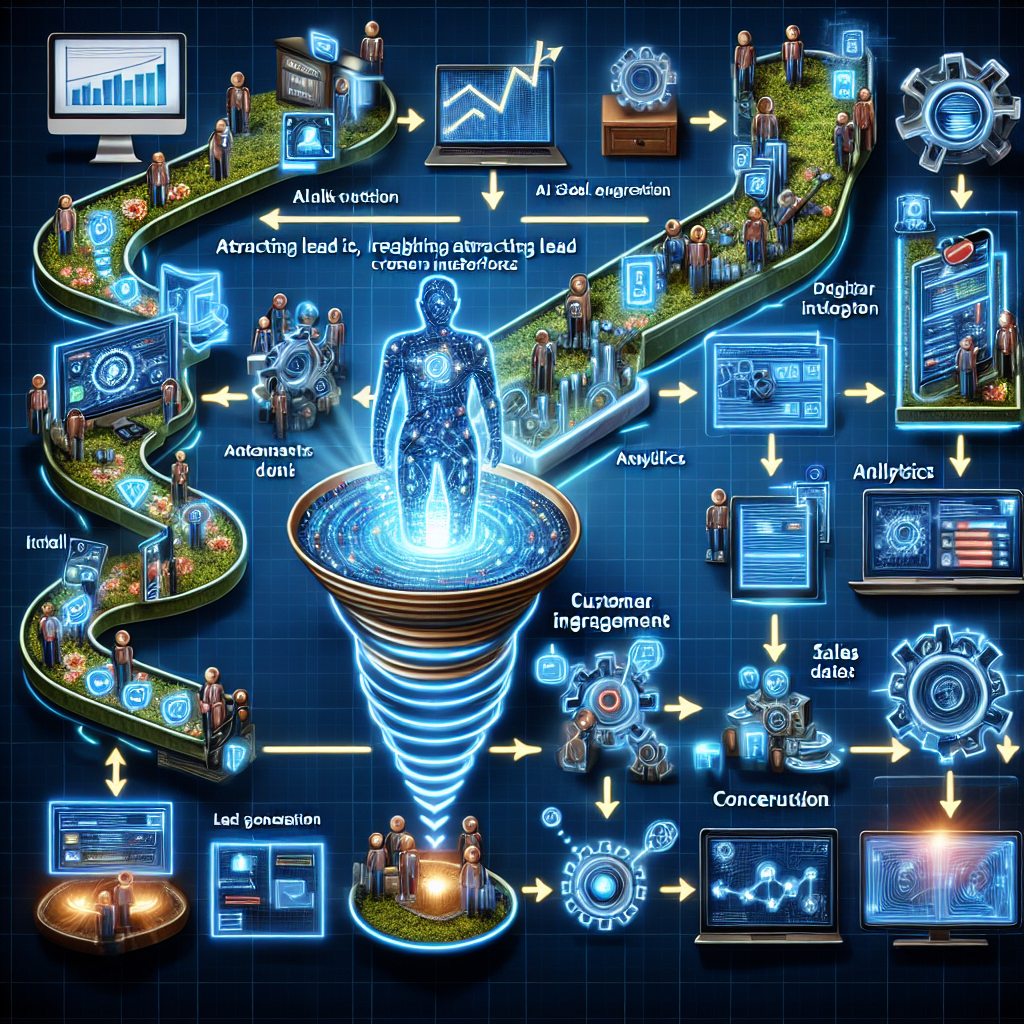
The benefits of AI-driven sales funnels are vast and transformative, offering businesses unprecedented opportunities to enhance their sales processes and drive revenue growth. One of the most notable advantages is the ability to achieve hyper-personalization. AI can analyze customer data to create tailor-made experiences for each prospect, ensuring that every interaction is relevant and engaging.
Another significant benefit is the automation of repetitive tasks. AI can handle tasks such as lead nurturing, follow-up emails, and data entry, freeing up your sales team to focus on more strategic activities. This not only boosts productivity but also reduces the risk of human error, ensuring a more efficient sales process.
AI-driven sales funnels also provide real-time analytics. Through continuous monitoring and analysis of key performance indicators, AI can offer actionable insights that help businesses optimize their sales strategies. This data-driven approach enables companies to make informed decisions quickly, adapting to market changes and customer needs more effectively.
Predictive analytics is another powerful feature of AI-driven sales funnels. By analyzing historical data and identifying patterns, AI can forecast future trends and customer behaviors. This allows businesses to anticipate market demands, adjust their strategies accordingly, and stay ahead of the competition.
Moreover, AI enhances lead scoring accuracy. Traditional lead scoring methods often rely on static criteria, but AI can evaluate a broader range of factors, including behavioral data and interaction history, to score leads more accurately. This ensures that sales teams can prioritize high-quality leads, improving conversion rates.
Finally, AI-driven sales funnels contribute to a more streamlined and cohesive customer journey. By integrating various touchpoints and ensuring consistent communication, AI helps build stronger relationships with prospects, ultimately leading to higher customer satisfaction and loyalty.
Key AI Technologies for Sales Funnels

Incorporating AI technologies into your sales funnels can significantly enhance performance and drive revenue growth. Several key AI technologies stand out in transforming how businesses manage their sales processes.
Machine Learning is at the forefront of AI-driven sales funnels. By analyzing vast amounts of data, machine learning algorithms can identify patterns and trends that human analysts might overlook. This enables more accurate predictions of customer behavior, allowing businesses to tailor their marketing strategies effectively.
Natural Language Processing (NLP) is another critical technology. NLP allows AI systems to understand and respond to human language in a way that feels natural. This is particularly useful for chatbots and virtual assistants, which can engage with customers in real-time, providing instant support and personalized recommendations.
Predictive Analytics is a powerful tool that leverages historical data to forecast future outcomes. By predicting customer behavior, sales teams can prioritize leads more effectively and tailor their outreach strategies to maximize conversions.
Customer Relationship Management (CRM) Integration with AI technologies can also revolutionize sales funnels. AI-enhanced CRMs can provide deeper insights into customer interactions and preferences, enabling more personalized and effective communication. This integration ensures that every touchpoint is optimized for conversion.
Another vital technology is Automated Lead Scoring. Traditional lead scoring methods can be time-consuming and often lack accuracy. AI can automate this process by evaluating a wide range of data points, including engagement history and behavioral patterns, to score leads more accurately and efficiently.
Sentiment Analysis is also gaining traction in AI-driven sales funnels. By analyzing customer feedback and social media interactions, sentiment analysis can gauge customer satisfaction and identify potential issues before they escalate. This proactive approach helps businesses maintain positive customer relationships and improve their offerings.
Finally, Recommendation Engines powered by AI can enhance cross-selling and upselling opportunities. By analyzing customer purchase history and preferences, these engines can suggest relevant products or services, increasing the likelihood of additional sales and boosting overall revenue.
Implementing AI Strategies Effectively
Implementing AI strategies effectively is crucial for maximizing the benefits of AI sales funnels. To ensure success, businesses must follow a structured approach that includes careful planning, integration, and continuous optimization.
The first step is to define clear objectives. Understand what you want to achieve with AI, whether it’s increasing lead generation, improving customer engagement, or optimizing conversion rates. Clear goals will guide the selection of appropriate AI technologies and strategies.
Data quality is paramount. AI systems rely on vast amounts of data to function correctly. Ensure that your data is clean, accurate, and up-to-date. Invest in robust data management practices to maintain data integrity, which will, in turn, enhance the performance of AI algorithms.
Next, focus on seamless integration. AI technologies should integrate smoothly with your existing systems, such as CRM and marketing automation platforms. This ensures that data flows uninterruptedly across all touchpoints, providing a holistic view of customer interactions and enabling more effective decision-making.
Training your team is also essential. Educate your staff about the capabilities and limitations of AI tools. Provide training sessions to help them understand how to interpret AI-generated insights and incorporate them into their workflows. A well-informed team can leverage AI more effectively, driving better results.
Monitor performance continuously. AI strategies are not set-and-forget solutions. Regularly evaluate the performance of your AI systems to identify areas for improvement. Use key performance indicators (KPIs) to measure success and make data-driven adjustments to optimize outcomes.
Another critical aspect is to maintain a customer-centric approach. While AI can automate many processes, it’s essential to ensure that the human element remains intact. Personalized interactions and empathy should still be at the core of your customer engagement strategies.
Finally, stay updated with the latest advancements in AI technologies. The field of AI is continuously evolving, with new tools and techniques emerging regularly. Keeping abreast of these developments will enable your business to adopt cutting-edge solutions and maintain a competitive edge.
By following these steps, businesses can implement AI strategies effectively, transforming their sales funnels into powerful engines of growth.
Future Trends in AI Sales Funnels

The future of AI sales funnels is brimming with potential, promising to revolutionize the way businesses interact with customers and optimize their sales processes. As technology advances, several trends are poised to shape the landscape of AI-driven sales funnels.
One of the most significant trends is the rise of hyper-personalization. AI algorithms are becoming increasingly sophisticated, capable of analyzing vast amounts of data to deliver highly personalized experiences. This means that sales funnels can be tailored to individual customer preferences and behaviors, leading to higher engagement and conversion rates.
Voice and conversational AI are also set to play a pivotal role. With the growing popularity of voice assistants like Amazon’s Alexa and Google Assistant, integrating voice capabilities into sales funnels can enhance customer interactions. Conversational AI can provide real-time support, answer queries, and guide customers through the sales process, making it more seamless and efficient.
Another trend is the use of predictive analytics to anticipate customer needs. AI-driven predictive models can analyze historical data to forecast future behaviors, enabling businesses to proactively address potential issues and seize opportunities. This can result in more effective marketing campaigns and higher sales.
The integration of AI with augmented reality (AR) and virtual reality (VR) is another exciting development. These technologies can create immersive and interactive experiences, allowing customers to visualize products in real-world settings before making a purchase. This can significantly enhance the decision-making process and boost conversion rates.
Moreover, the automation of repetitive tasks through AI will continue to evolve. By automating routine activities such as data entry, lead scoring, and follow-ups, sales teams can focus on more strategic tasks, improving overall efficiency and productivity.
As AI technology advances, we can also expect to see better integration with other business tools. Seamless connectivity between AI systems and platforms like CRM, ERP, and marketing automation will provide a unified view of customer interactions, enabling more informed decision-making.
Lastly, the importance of ethical AI cannot be overstated. As AI becomes more pervasive, businesses must prioritize ethical considerations, ensuring transparency, fairness, and accountability in their AI implementations. Building trust with customers through responsible AI practices will be crucial for long-term success.
Embracing these future trends in AI sales funnels will empower businesses to stay ahead of the competition and drive sustained growth. If you’re ready to explore how these innovations can transform your sales processes, contact me to Schedule Your Free Discovery Session – Today!