
SEC_03 // ABOUT
I built the content refinery I always needed.
Before that, I spent a career where the words had to hold: a Minneapolis fireground, product leadership at SunPower, Elevance Health, and Verisae, and a publisher’s desk with a shelf of non-fiction titles behind it. Every stop taught the same lesson: when the words are wrong, the system reads as broken no matter how well it runs. This is my journey, and Kaperider is where it pays out in your copy.
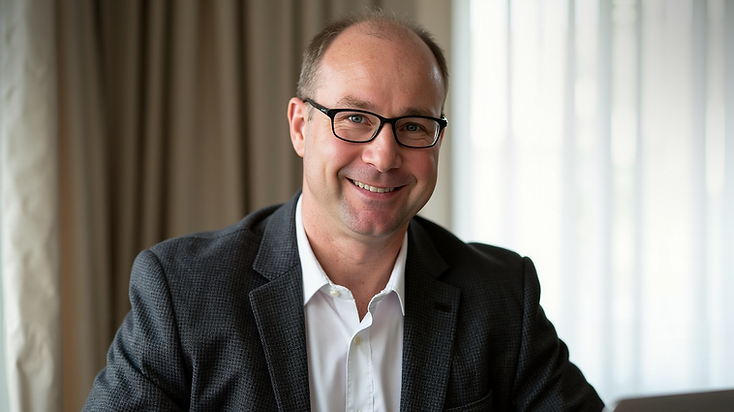
What I believe
“When you write, it is very easy to dream. This is one of the most beautiful activities. A writer can’t help but be a dreamer.”
“Writers don’t just craft stories. They leave behind blueprints for thought, roadmaps for those seeking direction, and bridges between hearts and minds that may never meet.”
Copy you can vouch for, or copy you can only hope about. I only work on the first kind.
The kid who took things apart
As a child I was endlessly curious about how things worked. I took apart gadgets, analyzed systems, deconstructed ideas, and, more often than not, put them back together with a piece left over. That habit never left. It eventually took an official form: degrees in Mathematics and English. One discipline for how things work. One for how they get explained. I have used both every day since, because a good piece of copy is a machine that has to run and a story that has to land, at the same time.
The fire service
After college I became a professional firefighter in Minneapolis. The fireground teaches lessons that never leave you: stay calm under pressure, assess fast, decide once, execute as a team. I kept one line from those years, and I have run every deadline since by it. Chuck Yeager said it: “At the moment of truth, there are either reasons or results.”
While I was still riding the rig, I consulted nights and weekends on digital marketing and product strategy, helping businesses launch products and sharpen their brands. The pattern of my career was already set: systems on one side, words on the other, and me in the middle translating.
The product years
I moved into digital strategy and product leadership, building and scaling software at SunPower Corporation, Elevance Health, and Verisae, across SaaS, renewable energy, and enterprise software. Here is the lesson those years burned in: the product is never the whole product. Somewhere between the roadmap and the customer stands a paragraph, and the paragraph usually wins. When the words are wrong, the system reads as broken no matter how well it runs.
The publisher's desk
I have taken 25 non-fiction titles from idea to retail, across business, self-development, and genre non-fiction. Publishing taught me the discipline this whole practice runs on: a manuscript has to say exactly what it means, keep its facts straight across two hundred pages, and survive a lawyer’s read. When you have shipped books, you stop thinking of editing as decoration. Editing is load-bearing.
The trust gap, and Lucidry
Then AI arrived, and I watched the trust gap open. The tools got good fast. The receipts did not exist. Writers adopted the leverage and lost the ability to vouch for their own work, and buyers were left holding polished text they could not audit.
So I built the thing I had needed my entire career: Lucidry, a content refinery that runs every draft through source checks, contradiction detection, protected-field integrity, and independent scoring, and returns a receipt. Kaperider is my copywriting practice, and it is the only one that runs on it.
Every deliverable that leaves this desk ships with a change log: what the refinement touched, what it protected, how the final text scored. You are never asked to take my word for it. The receipt is the word.
Why the name is Kaperider
Kaperider is the word copywriter, spelled the way it sounds. Say it out loud and you have the job title. Look at it on the page and you have a small lesson in what this work is. A phonetic spelling changes the letters and keeps the sound. Good copywriting does the reverse: it can change every word on the page, and the meaning still has to arrive intact. When the meaning does not survive the rewrite, that is not refinement. It is a polished error, and it never leaves this desk.
Latest from the Insights
Short essays on copy with receipts, the trust gap, and how a mechanic-first practice ships writing you can vouch for.
Oct 21, 2026
Who I Work With: B2B Marketing Leaders at $5M to $50M Companies
I work with B2B marketing and growth leaders at companies between $5M and $50M in revenue. If your team is producing more AI-assisted content than the company ever has and nobody owns the claims, here is what working together looks like.
Read the articleOct 19, 2026
How to Use AI for Copywriting Without Losing the Facts
Most teams use AI backwards. A four-stage process: claims brief first, generative drafting second, machine verification third, human-in-the-loop editing last.
Read the articleOct 16, 2026
When AI Writes the First Draft, Who Signs for It?
70% of writers now use AI. 60% do not trust their own AI-assisted work. The people producing the copy cannot vouch for it, and the buyers sense it. Here is what signing means now that a machine writes the first draft.
Read the articleOct 16, 2026
Kaperider Launches New Website for "Copy With Receipts" Copywriting Practice
Kaperider announces the launch of its rebuilt website at kaperider.com, the home of its "copy with receipts" copywriting practice. Every deliverable ships with a change log and an independent quality receipt.
Read the articleElsewhere
More about Daniel, in his own writing.