
From Armor to Aliveness: Letting Go Without Falling Apart

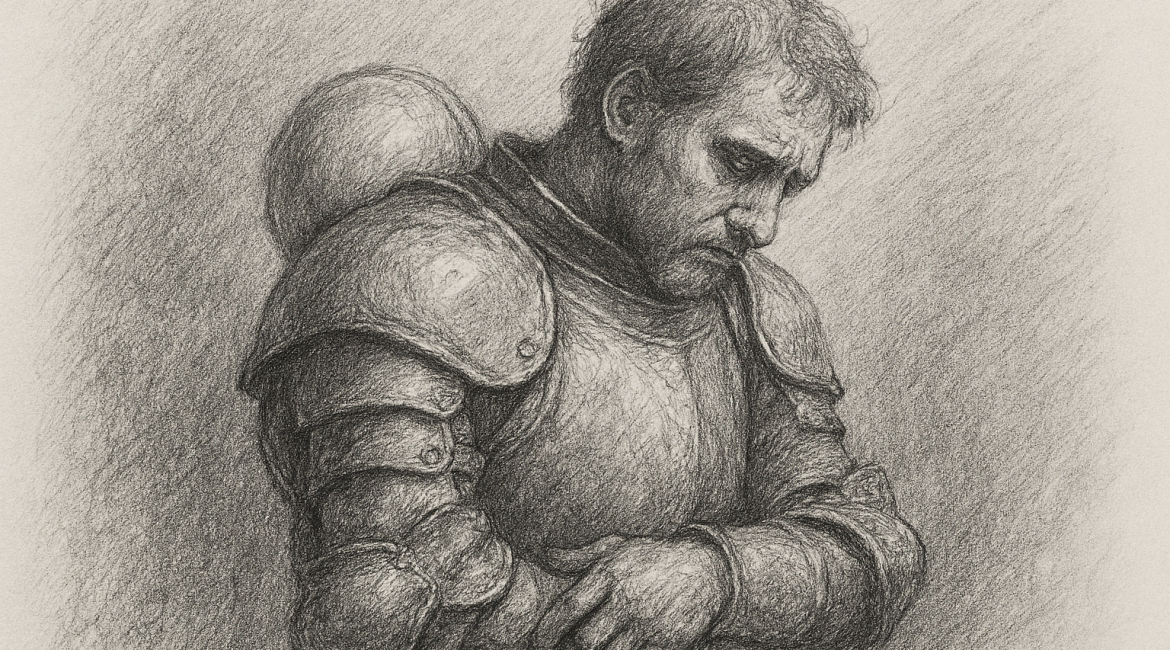
A weary knight in dented armor stands in solemn reflection, symbolizing the emotional weight of perfectionism and the quiet longing to be seen without the mask of achievement.

Imagine a knight who never removes his armor. At first, it’s noble. Necessary. It protects him from the battlefield, the arrows, the ambushes. But years go by. The war ends. The crowds disperse. The only thing left is the clang of his own footsteps inside the echo of iron. He’s safe. But he’s alone.

This is the armor of achievement. And if you’re reading this, maybe you’ve worn it, too.

Not the kind forged from metal—but from accolades, perfectionism, performance, and control. It kept you protected. It gave you a script. It made you admirable.

But here’s the truth: success that was once your sanctuary has quietly become your solitary confinement.

What: When Achievement Becomes Armor

Achievement starts as a light. It beckons. It gives purpose. It says: “Do more, be more, prove more.” And you do. You rise. You build. You hustle.

But somewhere along the way, it stops being about passion and starts being about protection.

  • Protection from rejection

  • Protection from inadequacy

  • Protection from being truly seen

Each milestone becomes a brick. Each title becomes a lock. Each smile becomes a mask. And the armor hardens.

Ask yourself:

  • Do you overperform when you’re under pressure?

  • Do compliments feel like obligations to maintain the image?

  • Do you feel more comfortable being admired than being loved?

If yes, then you’re not alone. You’re just armored.

So What: When Protection Blocks Connection

Armor doesn’t discriminate. It blocks the bad—but also the good.

You may have noticed it:

  • You achieve more but feel less.

  • You connect widely but intimately with few.

You’re surrounded by people but haunted by loneliness.

Here’s the paradox: the very thing that made you feel powerful is now making you feel paralyzed.

Psychologically, this is the cost of hypervigilance—a nervous system stuck in defense mode. According to trauma expert Dr. Bessel van der Kolk, when the body remains braced for danger, it suppresses vulnerability, joy, and even physical intimacy.

We become trapped in roles. The “responsible one.” The “successful sibling.” The “one who always has it together.” But inside? There’s a soft, aching part of you that whispers, Can someone love me without the costume?

That whisper matters.

Now What: Letting Go Without Falling Apart

A tired knight, ready to unzip the persona.

You don’t have to destroy your armor to be free. You just need to learn how to unzip it, piece by piece, when safety allows.

1. Name Your Emotional Armor

Start with radical honesty. What’s your armor made of?

  • Perfectionism: “If I’m flawless, I won’t be hurt.”

  • Control: “If I handle everything, I won’t be abandoned.”

  • Humor: “If I make them laugh, they won’t see I’m hurting.”

  • Busyness: “If I stay moving, I won’t have to feel.”

Naming it makes it visible. And what we see, we can eventually release.

2. Identify the Trauma Beneath the Persona

The armor wasn’t built for fun. It was built for survival.

Somewhere in your story, being authentic cost you something—love, belonging, safety. So you adapted. That’s not weakness. That’s intelligence.

But now the threat is gone. And the persona persists.

It’s time to locate the wound beneath the performance. Therapy, journaling, somatic work—these aren’t luxuries. They’re the path home. Because if you never grieve who you had to become, you’ll never embrace who you truly are.

3. Create Safety Through Authentic Expression

What if strength wasn’t about defense, but about depth? True strength is staying open when your instinct screams to shut down.

Here’s how to start:

  • Practice micro-vulnerability: Share a fear, a story, or a need with someone you trust.

  • Track your triggers: Notice when you armor up—and why.

  • Rewire through repetition: The more you express your truth and survive it, the safer your body will feel.

Neuroscience backs this up. The amygdala—the brain’s fear center—can be reconditioned through consistent, safe exposure. Over time, you learn that vulnerability doesn’t equal danger. It equals connection.

Redefining Strength: From Fortress to Firelight

What if your success wasn’t your shield—but your spotlight? What if your story, in all its cracks and shadows, was the most magnetic thing about you? Letting go doesn’t mean falling apart. It means falling into truth.

It means:

  • Feeling deeply without fear

  • Being loved without pretense

  • Living unmasked, unfiltered, and unafraid

Because the point of healing isn’t to forget the pain—it’s to remember your power outside of it. You are not your productivity. You are not your persona. You are not the armor you built to survive. You are what remains when the armor falls off and the light stays on.

A Path to Wholeness

Letting go of the old armor doesn’t mean letting go of your edge. It means softening the grip. Rewriting the story. Making room for presence, not just performance. You don’t have to do this alone. There’s a roadmap for this. One that honors your strength while inviting your softness. “Strength isn’t the ability to hold it all in, it’s the courage to let some of it out.” Order “Unmasking Success” on Amazon today. Because the version of you that no longer needs to pretend is the version the world is waiting for.

_______________________________________
Introducing Insights Alchemy Newsletter
Let’s keep your edge sharp! If this book shifted something in you, a spark of insight, a fresh perspective, a challenge to the status quo, imagine a steady stream of those sparks landing in your inbox, week after week. AILKEMY isn’t your average newsletter. It’s where real-world grit meets forward-looking strategy. We'll curate research, human-centered frameworks, and hard-won lessons to help you lead with empathy and clarity.
Kaperider newsletter e1752550699862 Imagine a knight who never removes his armor. At first, it's noble. Necessary. It protects him from the battlefield, the arrows, the ambushes. But years go by. The war ends. The crowds disperse. The only thing left is the clang of his own footsteps inside the echo of iron. He’s safe. But he’s alone.
Each newsletter delivers crisp foresight, actionable strategy, and narrative-driven insight, so you don’t just keep pace. You stay ahead. It’s free to start. It’s purposeful. And it’s built for thinkers who want more than ideas. They want impact.

SUBSCRIBE TO AILKEMY