
The Nervous System Revolution: Why Your Body Resists What Your Mind Wants

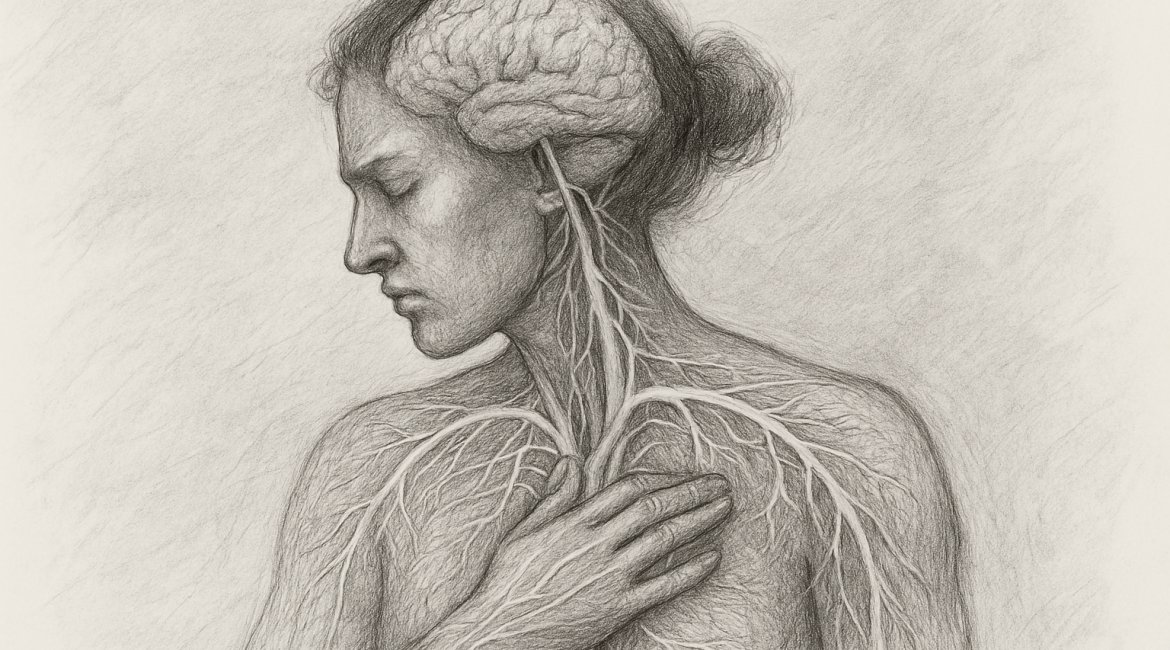
Illustration of a person in profile with their hand over their heart, illustrating the nervous system extending from the brain down the spine, symbolizing the connection between mind and body in healing and transformation.

Your body experiences vulnerability as danger while your mind knows it’s necessary for healing – no wonder transformation feels impossible.

You’ve read the books. You’ve done the inner work. You understand the concepts of healing, growth, and transformation. But when the moment comes—when vulnerability is required—your body resists. Hard. Why?

Your nervous system perceives vulnerability as danger, even when your conscious mind knows it’s necessary for healing. This internal contradiction creates a silent war within you: your rational mind urges you toward openness, but your body, shaped by past experiences, shuts down in self-protection.

Let’s explore why this happens and, more importantly, how you can work with your body rather than against it.

Why Your Nervous System Resists Change

The human nervous system is designed to prioritize survival over growth. It operates on a fundamental principle: if something has hurt you before, it may hurt you again.

 Trauma Imprints: The Body Keeps the Score

When we experience emotional wounds—whether through betrayal, abandonment, or other forms of trauma—our nervous system encodes these events as threats. This is why:

  • You may logically understand that a loving relationship requires emotional openness, yet feel intense fear when you try to be vulnerable.

  • You may recognize that public speaking isn’t life-threatening, yet experience shaking, sweating, or nausea before stepping onto a stage.

  • You may desire deep friendships but find yourself avoiding connection because intimacy once led to pain.

Your body isn’t sabotaging you—it’s protecting you. This is the paradox of healing: what once kept you safe now holds you back.

The Primitive Brain vs. The Rational Brain

Your amygdala, the primal part of your brain, processes threats in milliseconds—far faster than your logical mind. This means:

  • Before you can even rationalize why you feel anxious, your body has already activated a defense mechanism.

  • Your breath shortens, your muscles tighten, and your heart races before you even realize you’re in “protection mode.”

  • The prefrontal cortex, responsible for reasoning and logic, struggles to override these automatic responses.

So when you say, “I should be able to handle this,” and your body reacts otherwise, it’s not a failure of willpower—it’s neurobiology at work.

Introducing the REDIRECT Method™: Aligning Mind and Body

A person with their nervous system illuminated, showing the tension between fear and healing as the body resists vulnerability while the mind seeks transformation.

If fighting against your nervous system doesn’t work, what does? The REDIRECT Method™. This approach respects the biological need for safety while expanding your ability to tolerate vulnerability.

R – Recognize and Reframe Threat Perception

Instead of dismissing fear, acknowledge it. Your nervous system is trying to protect you based on outdated information. Begin by:

  • Naming the reaction: “I feel unsafe because my nervous system has learned that vulnerability is dangerous.”

  • Reframing the experience: “This isn’t a real threat—it’s an old response resurfacing.”

E – Establish Physiological Safety

You cannot think your way into safety; you must feel it. Create safety in your body through:

  • Deep breathing (activates the parasympathetic nervous system, reducing stress responses).

  • Grounding techniques (pressing feet into the floor, holding a weighted object, focusing on sensory details).

  • Self-touch (placing a hand over your heart, applying gentle pressure to your arms or legs).

D – Develop a Window of Tolerance

Growth isn’t about force; it’s about expansion. Instead of overwhelming yourself with high-intensity challenges, practice graduated exposure:

  • If public speaking is terrifying, start with voice notes to yourself, then progress to speaking in front of one trusted person.

  • If emotional vulnerability feels unsafe, begin with journaling your thoughts before sharing them with someone you trust.

  • If touch feels triggering, start by self-massage or comforting gestures before engaging in affectionate touch with others.

I – Integrate New Experiences Gradually

Healing happens through experience, not theory. When you successfully navigate small, safe moments of vulnerability, your nervous system learns that openness does not equal danger.

R – Regulate Before You Reflect

It’s tempting to analyze our emotions when we’re dysregulated. Instead, regulate first, then reflect:

  • If you feel anxious, move your body before overthinking the situation.

  • If you feel frozen, engage in rhythmic movement (rocking, walking, dancing) to signal safety to your nervous system.

  • Once calm, THEN process your emotions cognitively.

E – Engage in Co-Regulation

Healing doesn’t happen in isolation. The nervous system thrives on safe, supportive connections:

  • Spend time with emotionally regulated people.

  • Practice eye contact, gentle touch, and active listening with loved ones.

  • Allow yourself to receive support rather than hyper-independence.

C – Cultivate a New Identity

The way you see yourself shapes your nervous system’s expectations. Shift from “I am someone who struggles with vulnerability” to “I am learning to trust my body and expand my capacity for openness.”

T – Trust the Process

Neural pathways take time to rewire. Some days will feel like progress, others will feel like setbacks. Both are part of the process.

The Freedom of a Nervous System That Supports You

Imagine moving through life without anxiety hijacking your best intentions.

  • You express yourself without the fear of rejection overriding your voice.

  • You connect with others without the instinct to flee or shut down.

  • You navigate discomfort without spiraling into survival mode.

This is what happens when your mind and body align. When you teach your nervous system that vulnerability is safe, transformation stops being a battle and starts being a natural evolution.

You Are Not Broken, You Are Protecting Yourself

If you’ve spent years feeling like your body is working against you, know this: It’s not sabotage—it’s protection. The protection can be rewired. You are not broken; you are adaptive. Healing isn’t about pushing harder; it’s about learning how to expand safely. The REDIRECT Method™ isn’t about forcing yourself into vulnerability but gently guiding your nervous system toward safety and trust. The revolution isn’t about fighting your body. It’s about working with it.

_______________________________________
Introducing Insights Alchemy Newsletter
Let’s keep your edge sharp! If this book shifted something in you, a spark of insight, a fresh perspective, a challenge to the status quo, imagine a steady stream of those sparks landing in your inbox, week after week. AILKEMY isn’t your average newsletter. It’s where real-world grit meets forward-looking strategy. We'll curate research, human-centered frameworks, and hard-won lessons to help you lead with empathy and clarity.
Kaperider newsletter e1752550699862 Your body experiences vulnerability as danger while your mind knows it's necessary for healing – no wonder transformation feels impossible.
Each newsletter delivers crisp foresight, actionable strategy, and narrative-driven insight, so you don’t just keep pace. You stay ahead. It’s free to start. It’s purposeful. And it’s built for thinkers who want more than ideas. They want impact.

SUBSCRIBE TO AILKEMY