
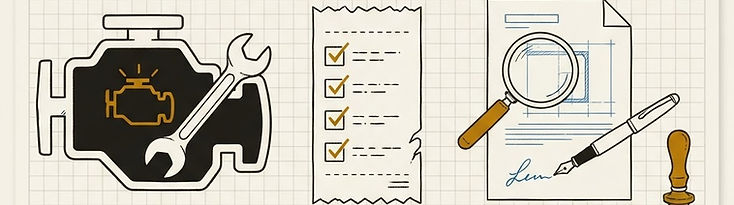
When the copy is not the problem, the most expensive copywriting advice in B2B marketing is also the most common: write more.
Results sag, so someone commissions a new landing page. Then a new email sequence. Then a fresh sales one-pager. Twelve months later the shelf is heavier and the numbers have not moved.
Mechanic-first copywriting starts from a different diagnosis. The copy was never the problem. The system that decides what the copy says is the problem.
What is mechanic-first copywriting?
Mechanic-first copywriting diagnoses the messaging system behind weak results, then fixes the cause before producing any new copy.
The short answer: it starts with diagnosis. Before writing a page or an email, we find where the message fails: positioning, proof, sequence, or offer.
A good mechanic does not begin by installing a new engine. They ask what the engine is actually doing before they touch a wrench. The check engine light is a symptom, not a cause.
Weak conversion rates are the same kind of light.
Why does more copy usually fail?
Most teams ask for more copy because more copy is the cheapest thing to commission. Words feel like progress.
But new copy written on top of a broken messaging system just multiplies the breakage. If your landing page claims a 40 percent saving and your deck promises a 25 percent one, a fourth email will not reconcile them. It will widen the contradiction.
Nobody did anything wrong. Nobody was assigned to keep the claims in line across assets, because that job barely existed when a company produced two assets a quarter.
Now a company produces forty. The system of record for what you claim, in what order, with what proof, has to be built on purpose. It will not emerge on its own.
What does the diagnosis examine?
Four failure points, before any drafting starts.
Positioning. What you say you are. If the positioning is off, every asset built on it inherits the error.
Proof. What you can demonstrate. Claims without proof read as noise to professional buyers, and buyers punish unproven claims harder than modest ones.
Sequence. The order claims arrive in. The same claims in a different order produce different conversion, because attention is spent in a specific direction.
Offer. What the buyer is actually being asked to trade. If the offer is unclear, no headline rescues it.
Diagnosis of those four points produces a list. The list says what to fix first, second, and third. Sometimes the diagnosis reveals that copy is not needed at all yet, and the honest finding is to say so.
What does a mechanic-first engagement look like?
Three working parts.
Truth intake before drafting. The claims, numbers, and sources enter the record before any writing does. If a claim cannot be sourced, it does not go in. This is slower than starting with a blank page, and faster than defending an unproven number in a deal review six weeks later.
A messaging blueprint every asset shares. One page of decisions, so the website, the emails, and the sales deck quote the same claims in the same order. New assets are not written from taste or memory. They are built against the blueprint, and anything that contradicts it gets flagged at drafting time, not after publication.
Proof attached to every claim. Each claim in the blueprint carries its evidence. The proof travels with the copy, not as a footnote to it. A reader can check the receipt the way they would check an invoice.
Where does AI fit in a mechanic-first process?
Drafting, mostly. The machine produces candidate text fast, and speed of production is genuinely useful once the system of decisions is set.
The verification is not AI-led. Every claim, number, name, and quote is checked before it ships. This is the discipline behind the receipts: a change log on every deliverable, and a quality score produced independently of the drafting process.
The refinery that runs that verification is Lucidry, the content refinery behind Kaperider's work. It was built because the volume of modern content requires machine checking, and because a mechanic's work is only as good as the inspection at the end of the line.
Human-led, AI-assisted, and verified. The final word is always owned by a person who signs for it.
Who is mechanic-first copywriting for?
B2B marketing and growth leaders at companies between $5M and $50M in revenue.
Usually the pattern is the same. The team produces a high volume of AI-assisted content, output has multiplied, and confidence in the claims has not kept pace. Conversion drifts. Someone senior asks, correctly, whether anyone can still vouch for what the company says about itself.
If that question has an uncomfortable answer, the system needs a diagnosis before it needs another writer.
Kaperider is the copywriting practice. Lucidry is the refinery behind the work.
Two minutes with the brief form is enough to begin. The messaging blueprint shows what the system produces, the proof of work shows the ledgers it ships with, and The Offer shows what an engagement includes.
Questions
- Is the copy itself AI-written?
- No. The work is human-led and AI-assisted. The machine drafts and checks at high volume inside boundaries a person sets. Daniel owns every final word.
- What should you bring to a first conversation?
- The assets that worry you most. Not the best ones. A landing page, a deck, an email sequence, and the numbers behind them. The diagnosis starts there.